~ The Moral Lab ~

Bell Building, St. Phillips Street
Room 221/222
wrightjj1 @ cofc . edu
I am always on the look out for good research assistants
Anyone interested in getting involved in my research lab is welcome to contact me: wrightlab @ cofc . edu.

PUBLICATIONS

RESEARCH INTERESTS

I am fascinated by how people of all ages experience, think about, and navigate what I call the "moral landscape". I call it this because it of the way our social/moral values, norms, and beliefs structure the social space we move through, much like the physical features around us structure the physical space we move through.

This interest has led to a variety of research projects, investigating:

  • children's discussions with other children and adults about moral issues and their early navigation (and exploration) of the moral landscape.

  • the role that imaginative play and gaming -- both in the form of imaginative role-playing and pretend play -- have in the development of moral reasoning, imagination, and perspective taking, as well as creative/divergent thinking.

  • what sorts of issues children, adolescents, and adults view as moral, as well as when and why this changes and how it informs their expressions of interpersonal tolerance towards dissimilar beliefs and practices and their willingness to engage with and help dissimilar others.

  • the dispositional, contextual and cognitive factors underlying people’s moral judgments.

  • how the perception of social/moral cues (e.g., harm, fairness, group membership, social hierarchy) influences children's, adolescents', and adults' judgments about social interaction: for example, their willingness to ascribe moral wrongness to particular types of transgressions or their willingness to condone morally wrong acts against others.

  • when and how children, adolescents, and adults perceive the moral landscape -- for example, when and how they perceive context-specific features of their environment to have moral relevance for their judgments and their behaviors.

  • identity formation in adolescents and the extent to which the presence of certain moral values positively (or negatively) influences self-perception, evaluation, and behavior.


CURRENT LAB ACTIVITIES

2012-2013 - Research projects:

Moral Foundation Personality Inventory
The psycho-social function of meta-ethical pluralism
The role of pretend play in young children's moral development
A "motivated cognition" model of moral foundation theory
A developing understanding of moral humility in children

2011-2012 - Research projects:

Motivated moral perception: Do our moral judgments influence where we look? (cont'd)
Hemispheric processing of morally relevant cues: Does it matter if the man you're about to kill is on the left or the right? (cont'd)
Exploring the physiological and cognitive mechanisms underlying people's moral foundations (cont'd)
Young children's early moral lives: Evidence from parent-child conversations (cont'd)
Effects of moral conviction and social norm perception on health and sustainability-related behaviors
The development of moral character and feelings of self-worth in at-risk youth: A study of the WINGS program
Neural-network modeling of moral cognition

2010-2011 - Research projects:

Moral Foundations -- Individualizing vs. Binding Foundations
Moral Perception Bias
Exploration of Moral Foundations
Meta-Ethical Pluralism
Pretend Play as a Medium for Moral Exploration
Perception of Social Cues in Preschoolers' Interpretations of Social Interactions

2009-2010 - Research projects:

The Influence of Imaginative Role-Playing on Young Adults' Moral Development: We are exploring the the influence of imaginative role-playing (a simplified, structured version of Dungeons & Dragons) on moral reasoning, imagination, empathy, perspective taking, and creative thinking in young adults.
 

Pretend Play as a Medium for Early Moral Development: We are investigating pretend play as a medium for moral exploration in young children (ages 2-6 years old).
 
See No Evil, Hear No Evil, Do No Evil: We are using eye-tracking technology to study the relationship between people's visual attention to (and avoidance of) morally relevant stimuli and their moral judgments/attitudes about a variety of scenarios. Specifically, we are interested in if what people attend to predicts the sorts of moral judgments they form, as well as whether they will avoid attending to morally relevant information that is inconsistent with their extant moral attitudes.

Other ongoing studies:

Perceptions of Social Status research: Do people's perception of social status influence their moral judgments -- their judgments of fairness, blameworthiness, etc.? We are currently investigating this question in adults and adolescents.

In particular, we are conducting research on how adolescents think about a variety of social relationships and interactions. Our goal is to develop a better understanding of how adolescents of different ages perceive differences in social status and how those perceptions influence their interpretation of a range of social relationships and their judgments about positive and negative social interactions.

Mechanisms of Intolerance:
Our past research indicates that viewing an issue as moral is strongly predictive of intolerance and negative interpersonal behaviors towards dissimilar others. But what are the mechanisms behind this intolerance? We are currently exploring the extent to which such intolerance is driven by people’s meta-ethical commitments (viewing moral norms as either objectively or subjectively grounded) and strength of attitude.

We are also exploring the contextual and cognitive specifics underlying people’s meta-ethical commitments.

Young Children's Use of Moral Evaluatives: What sorts of moral concepts do young children use to talk about moral issues with their parents? Past research suggest that while they employ "good" and "bad" to discuss moral issues frequently, they rarely (if ever) employ "right" and "wrong". We are currently exploring this finding in greater depth in samples of both American and British children.

The Moral Suspiciousness of the Atheist: We are studying how people's moral judgments about a person's good and bad actions vary on the basis of that person's religious or non-religious beliefs.


Current Lab Conference Presentations

  • none currently scheduled

Past Lab Conference Presentations

  • Association for Moral Education, San Antonio, TX -- November, 2012

  • Experiments on Ethical Dilemmas: An Interdisciplinary Workshop, Institute of Philosophy, London, UK -- April, 2012

  • European Society of Philosophy and Psychology, Montreal, CA -- July, 2011

  • Association for Psychological Science, Washington DC -- May, 2011

  • Association for Moral Education, St. Louis, MO -- November, 2010

  • Southern Society for Social Psychology (click here to see pics)

  • Society for Philosophy and Psychology conference in Bloomington, IN June 12-14th

  • South Carolina Society for Philosophy, special session on Experimental Ethics, Rock Hill, SC Feb 2009

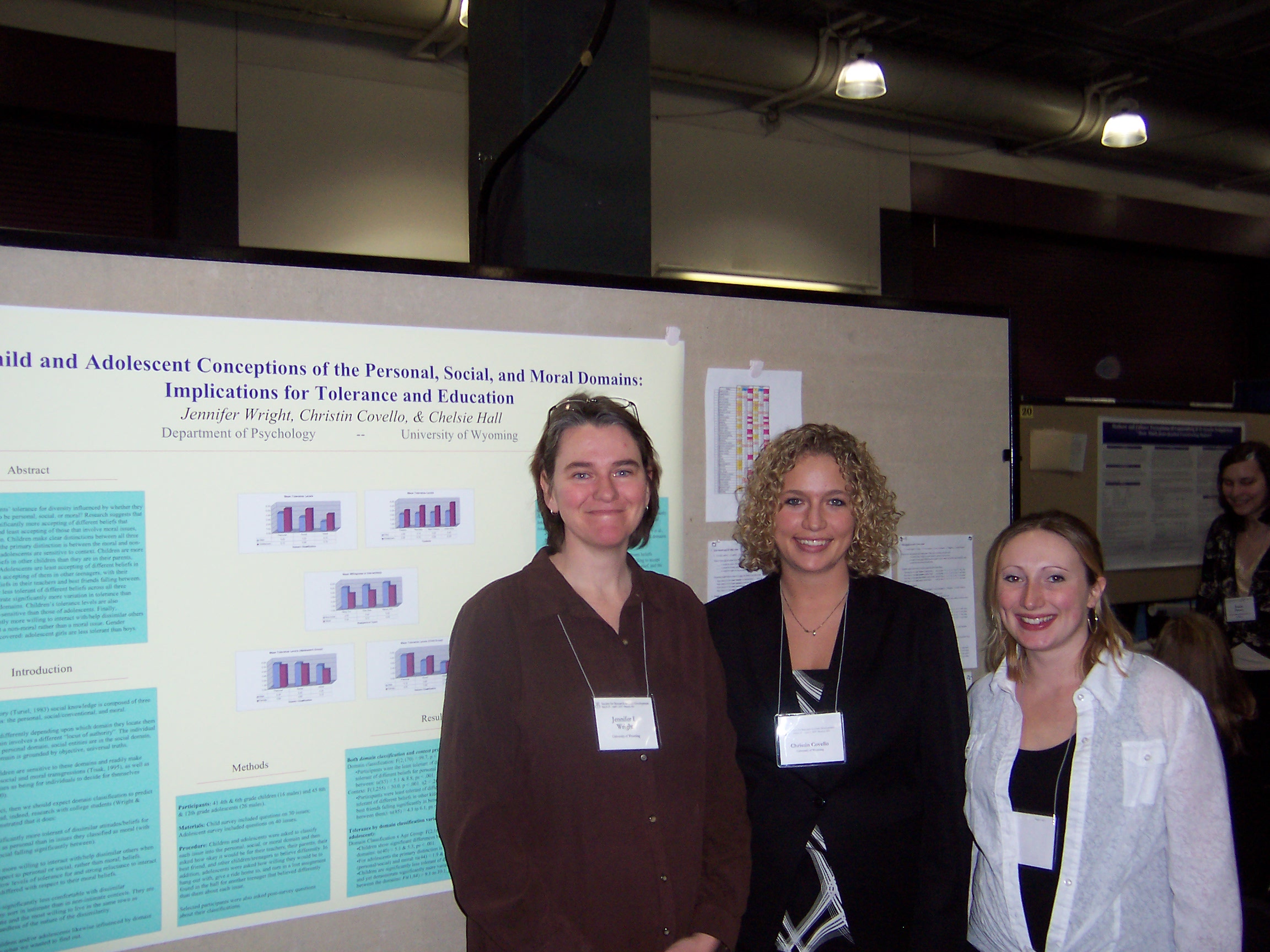
  • Society for Research in Child Development (SRCD), Boston, MA April 2007 (click here and here to see pics of the trip)

  • Rocky Mountain Psychology Association (RMPA), Park City, UT April 2006 (click here to see pics of the trip)

Current Bachelor's Essays & Independent Studies (BEIS) Projects
Matthew Echols, Psychology
Lauren Finkbiner, Psychology
Robert Hogston, Psychology
Sarah James, Psychology

Current Volunteer Research Assistants
Molly Hatch, Psychology
Nathan Wills, Psychology
Missy Barnett, Psychology
Andrea DeLeon, Women's & Gender Studies
Kacie Pollard, Psychology
Vivian Coleman, Psychology
Anna Grace Burnett, Psychology
Brittany Hickson, Psychology


Noteworthy Past Research Assistants & BEIS Projects (College of Charleston)

Evan Reinhold, Psychology
Sarah James, Psychology
Annie Galizio, Psychology
Michelle DiBartolo, Psychology
Ria Nochera, Psychology
Josh Edelson, Psychology
Christina Nguyen, Psychology
Alison Milz, Psychology
Meredith McCoid, Psychology
Sisi Tran, Psychology
Nicholas Zumpano, Psychology
Megan Currin, Psychology
Tara Edgens, Psychology
Elizabeth Silver, Psychology
Maria Jackson, Psychology
Claire DeBuys, Psychology
Christie Eichberg, Psychology
Haley Specter, Psychology
Robert Hogston, Psychology
Candice Thompson, Psychology
Sarah Sweeney, Psychology
Laken Shirey, Psychology/Biology
Jessica Putnam, Psychology
Chelsea Borgeson, Psychology
Nicholas Barclay, Psychology
Daniel Weisglass, Philosophy/Psychology
Javier Gomez-Lavin, Philosophy/Psychology
Emma Kate Wright, Psychology
Vanessa Sorenson, Psychology
Kelly Saulpaugh, Psychology
Rebecca Kastner, Psychology
Morgan Ridenhour, Psychology/English
Alison Bull, visiting student
Summer Howell, Psychology
Carra Bannan, Psychology
Jenny West, Psychology
Trisha Rogers, Psychology
Vanessa Minervini, Psychology
Michelle Hopkins, Psychology
Cullen Ben McWhite, Psychology
Stacey Brown, Psychology
Ashley King, Psychology
Trishna Symal, Psychology

Noteworthy Past Research Assistants (University of Wyoming)
Piper Grandjean, Psychology
Douglas Watt, Microbiology
Kenneth Englund, Psychology/Philosophy
Chelsie Hall, Psychology
Lindsey Devries, Psychology
Jeanna Condon, Psychology
Allison Land, Psychology
Jed Sawyer, Psychology
Ross Little, Psychology/Philosophy
Christin Covello, Psychology
Jodee Duncan, Psychology
Megan Rossi, Psychology

home